Turning public health records into reviewed outreach
The result In a live run on ten real organizations, nine drafts passed every check and the tenth fell back to the tested template, in 2 minutes 20 seconds at no cost. Nothing was sent: every draft waits for a person. How it got there
Problem
A medical billing team needs to reach hospitals and practices, but bought lists go stale and AI-written outreach invents facts. In healthcare a wrong claim in a first email costs the relationship, so nothing could go out on its own.
My role
I wrote the spec and the safety rules, built it with an AI coding agent, reviewed every change, and ran it against the live registry and a live model. I owned the data, the scoring, the drafting, the checks and the tests.
Outcome
In a live run on ten real organizations, nine drafts passed every check and the tenth fell back to the tested template, in 2 minutes 20 seconds at no cost. Nothing was sent: every draft waits for a person.
How I solved it
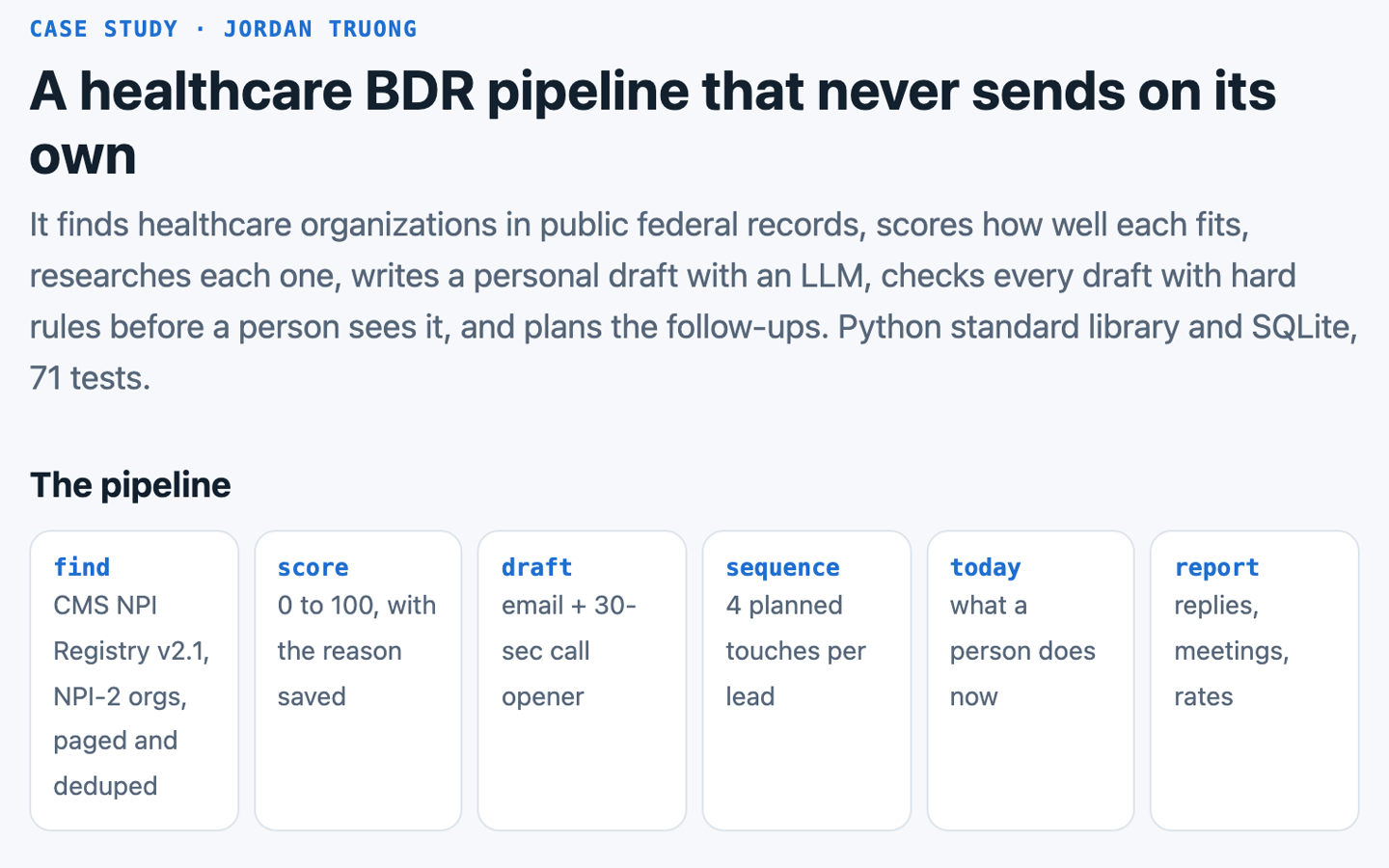
It pulls organization records from the public CMS NPI Registry, paged and deduplicated by NPI, and imports them in one transaction. Each organization gets a 0 to 100 fit score with the reason saved beside it.
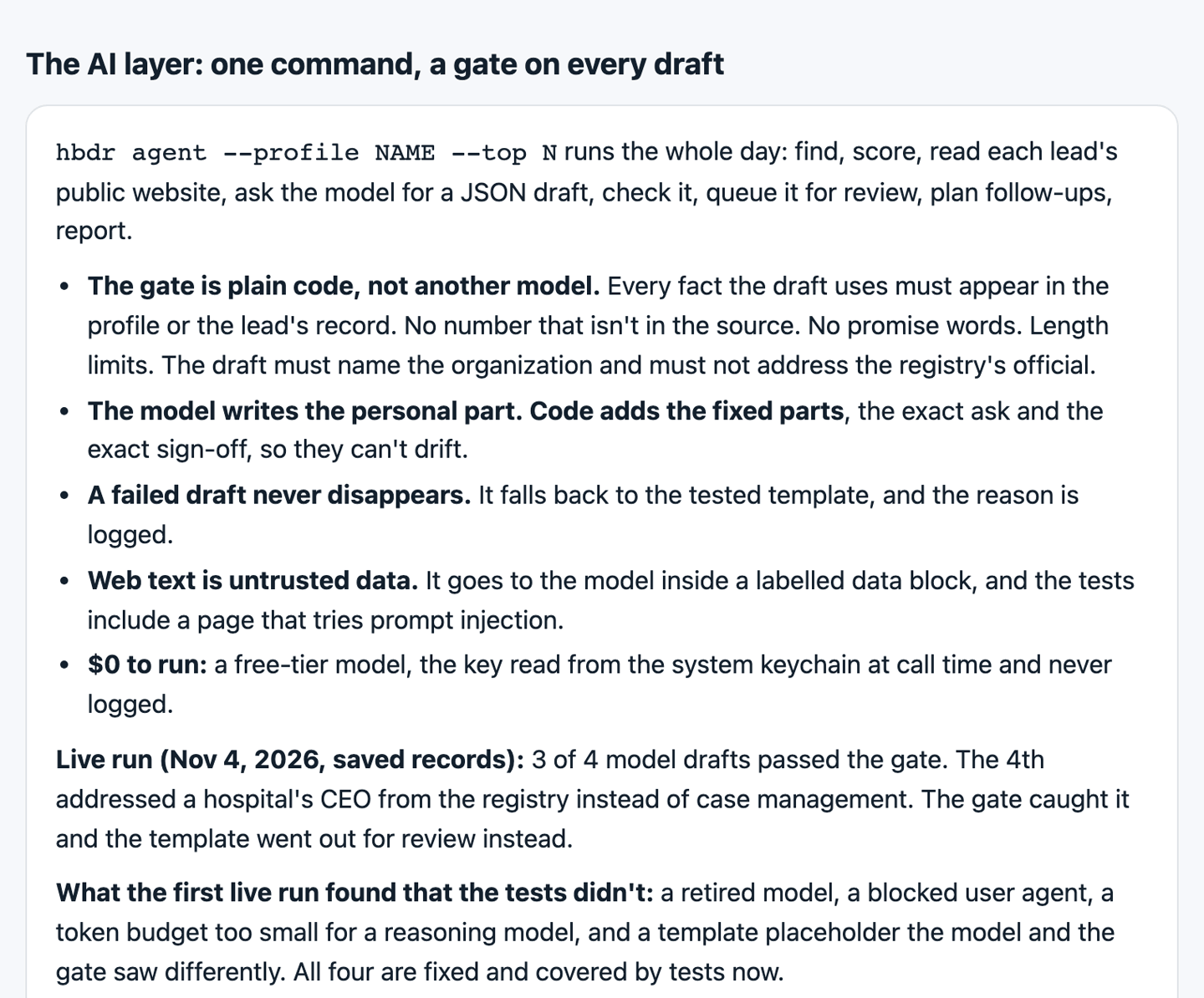
The model writes only the personal part, as JSON. Code adds the exact ask and sign-off, then a gate written in plain code checks the draft: every fact must appear in the source record, no number that is not in the source, no promise words, length limits, the organization named, and never the registry official as the contact. A draft that fails falls back to the tested template with the reason logged. Web text goes to the model as labelled data, and a test page tries prompt injection. 71 tests.
What shipped
The first live run found four problems the tests could not see: a retired model, a blocked user agent, a token budget too small for a reasoning model, and a placeholder the model and the gate read differently. Then free-tier rate limits failed five of ten drafts. Each fix has its own test now.
What worked
Keeping the checks in code instead of asking another model. On saved records the gate caught a draft that addressed a hospital CEO instead of case management, and the template went to review in its place.
What I’d Do Differently
Registry records carry no websites, so no lead was researched beyond its record. Before making drafts more personal I would add a second source, such as a business listing import, and measure reply rates against the template.
Working on something like this for your team? See how I work with businesses.